
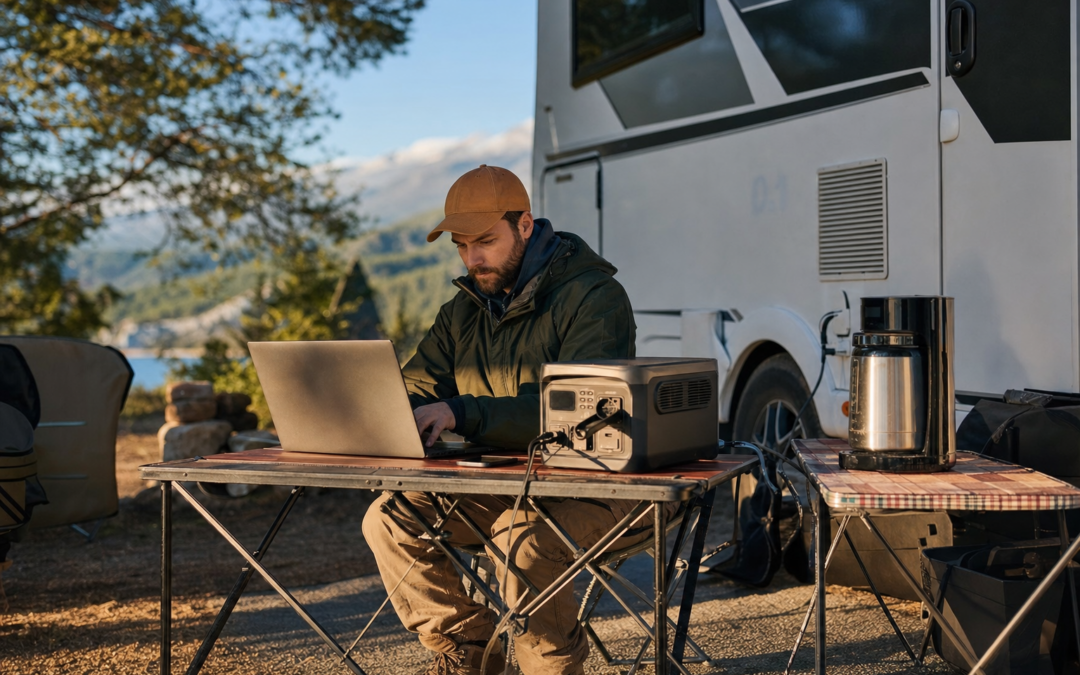
Portable power stations have become a staple for campers, RVers, and anyone who wants electricity off the grid. Whether you’re charging phones and cameras, running a CPAP at night, or keeping a 12V cooler going, compact lithium power units offer a quiet alternative to a gas generator—no fumes, no fuel. But with so many models listing different specs, it’s tough to know which one fits your needs.
How this roundup was put together: we did not bench-test these units. We researched and compared four portable power stations using the manufacturers’ published specifications (capacity, continuous and surge output, ports, charging inputs, weight and warranty) as listed on the product pages, then looked at how those numbers line up with typical camp and RV loads. Runtime figures below are estimates worked out from the listed specs, not measured results. For broader background, see our portable power station basics guide and review hub.
Why Portable Power Stations Matter for Camp and RV
Modern camping isn’t always about roughing it with a flashlight and a can of beans. From keeping your phone charged for navigation to powering a CPAP machine or portable cooler overnight, a power station can be a real upgrade. In RVs, they can serve as backup for shore power or as a supplement when boondocking. Unlike gas generators, they produce no exhaust and don’t need fuel, which makes them a popular option for everyone from tent campers to full-time RVers.
Key Specs to Compare Before You Buy
Before looking at specific models, it helps to understand the specs that separate one power station from another:
- Battery Capacity (Wh): Measured in watt-hours, this tells you how much energy the unit stores. More capacity means more run time for your devices.
- Output Power (W): The maximum continuous wattage the station can deliver. Make sure it covers your highest-draw device.
- Peak/Surge Power (W): Many appliances draw more power when starting. Surge ratings show what the station can handle for short bursts.
- Port Selection: Look for the mix of AC outlets, 12V DC, USB-A and USB-C your gear actually uses.
- Battery Chemistry: Lithium iron phosphate (LiFePO4/LFP) is generally rated for more charge cycles than standard lithium-ion.
- Weight and Portability: Think about how far you’ll carry it from your vehicle or campsite.
- Recharge Options: Check whether it can be topped up from a wall outlet, a car’s 12V socket and a solar panel—and the maximum input for each.
A quick way to estimate runtime: multiply the rated capacity by about 0.85 to allow for conversion losses, then divide by your device’s wattage. For example, a 288Wh unit gives roughly 245Wh usable, or around 12 hours for a 20W load. Real results vary with temperature, battery age and how much the device actually draws.
BLUETTI Elite 30 V2 Portable Power Station: Most Output in This Group

BLUETTI Elite 30 V2 Portable Power Station 288Wh 600W LFP Solar Generator Review — BLUETTI generators gear aimed at buyers who want clear specs before they click through. Key figures include 9.4 lbs, 600W, 1500W.
On paper, the BLUETTI Elite 30 V2 has the most capacity and output of the four models here. BLUETTI lists a 288Wh LFP (LiFePO4) battery, 600W continuous output and a 1500W “Power Lifting” mode, at a listed weight of about 9.4–9.5 lbs.
- Capacity and output (listed): 288Wh and 600W continuous, the highest figures in this roundup. That covers laptops, a CPAP and many small appliances within the 600W limit.
- Charging (listed): BLUETTI lists AC wall charging at up to 380W (adjustable to 200W), plus solar and car charging, and quotes 0–80% in about 45 minutes and 0–100% in about 70 minutes on AC.
- UPS function (listed): The manufacturer describes a 10ms UPS switchover, which matters if you want to keep a CPAP, router or laptop running through a brief outage.
- Warranty (listed): 60 months, the longest in this group.
- Estimated runtime: using the rule of thumb above, roughly 245Wh usable—around 12 hours for a 20W fan, or several full phone charges plus overnight lighting.
Based on the specs, the Elite 30 V2 is the pick here for campers who want the most headroom and the longest warranty, and a practical backup for smaller RVs or van builds. It’s also the heaviest and the most expensive of the four.
Daran Portable Power Station 89.6Wh: Ultra-Light for Minimalists

Daran Portable Power Station 89.6Wh LiFePO4 Battery 100W(200W Peak) Solar Review — Practical generators from Daran, summarized from hub features and listed measurements. Key figures include 6.5, 3.3, 89.
If you want something you can toss in a backpack or glovebox, the Daran 89.6Wh unit is one of the smallest options in this group. The listing gives dimensions of about 6.5 × 3.3 × 4 inches and a weight of 2.54 lbs, which suits solo overnight trips, tent campers who mainly charge phones and headlamps, or a short-outage backup.
- Output (listed): 100W continuous (200W peak). That fits phones, tablets, LED lights and small USB electronics—not AC appliances with a real heating element or motor.
- Battery chemistry (listed): an 89.6Wh LiFePO4 pack, which the manufacturer rates at 3,500+ cycles.
- Ports (listed): seven outputs including two AC sockets, plus DC and USB. The AC output is limited, but can handle a laptop or camera battery charger.
- Charging (listed): Daran lists four ways to recharge and quotes 0–80% in about 1.5 hours. It also describes fanless, silent operation and a built-in LED flashlight.
- Estimated runtime: roughly 75Wh usable—enough for several phone charges and a headlamp over a weekend, but not for running a cooler.
Based on the listed size and weight, this Daran unit is a sensible choice for minimalist campers or an emergency kit if you only need basic charging.
DaranEner Portable Power Station: Versatile Mid-Capacity Option

DaranEner Portable Power Station Review — An editorial look at this DaranEner option for generators — specs first, marketing second. Key figures include 300W, 3500, 10 .
The DaranEner (model NEOZ) sits between the ultra-light units and the BLUETTI. DaranEner lists a 192Wh LiFePO4 battery and 300W pure sine wave output (600W surge) at a listed weight of 5.73 lbs.
- Output and battery (listed): 300W continuous, 600W surge, and a cycle rating of 3,500+. On paper that covers a CPAP, laptops or a small 12V cooler.
- Ports (listed): six outputs—two AC outlets, one 60W USB-C PD, two 18W USB-A (QC3.0) and one 12V DC.
- Charging (listed): AC wall (100W max), car charger, or solar at up to 60W DC input. The 60W solar limit means solar top-ups will be slow compared with the BLUETTI.
- Size (listed): about 8.66 × 7.09 × 5.12 inches, with a built-in LED light.
- Estimated runtime: roughly 160Wh usable. A 12V fridge that averages 15–20W over a day could run for most of a day, depending on its duty cycle and the outside temperature.
For campers and RVers who want a balance of output, size and cycle life, the DaranEner is a mid-capacity option worth considering based on its specs.
HOWEASY Portable Power Station: Budget-Friendly and Simple

HOWEASY Portable Power Station,120W(240W Peak) Solar Generator Review — An editorial look at this HOWEASY option for generators — specs first, marketing second. Key figures include 8 , 2 , 6.6 .
The HOWEASY unit (model H120) is aimed at campers who want a low-cost backup for basic electronics. The listing describes an 88Wh battery, 120W AC output (240W peak) and a weight of about 2.3 lbs, with dimensions of about 6.6 × 4 × 3 inches.
- Output (listed): 120W is enough for phones, tablets and small fans, but not major appliances.
- Ports (listed): eight outputs, including two AC sockets, one 18W USB-C, two QC 3.0 USB ports and a standard USB port.
- Extras (listed): a built-in LED light with steady, flash and SOS modes.
- Charging (listed): three recharge methods (AC adapter, car charger and solar). An AC adapter and car charger are listed as included.
- Warranty (listed): 24 months.
- Battery chemistry: the listing we reviewed does not state the cell chemistry, so don’t assume LiFePO4-level cycle life.
- Estimated runtime: roughly 75Wh usable—similar to the Daran for phone and light charging.
The HOWEASY is a reasonable entry-level choice if you want backup power for gadgets and aren’t planning to run AC appliances.
How We Compared These Models
This roundup is a research-based comparison, not a hands-on test. For each model we:
- Collected published specs: capacity, continuous and surge output, port list, charging inputs, weight, dimensions and warranty, as stated by the manufacturer on the product listing.
- Checked the numbers against common camp loads: phones, headlamps, fans, CPAP machines, laptops and 12V coolers.
- Estimated runtimes from rated capacity using the rule of thumb above, and labeled them as estimates.
- Noted gaps: where a listing leaves out a detail (such as battery chemistry), we say so rather than guess.
Manufacturer figures are claims, not independent measurements. Before you buy, check the live product page for current specs and read recent verified owner reviews for real-world notes on noise, heat, charging speed and durability.
Battery Chemistry: Why LiFePO4 Is Worth Considering
Three of the four models here (BLUETTI, Daran and DaranEner) list LiFePO4/LFP batteries. Compared with standard lithium-ion, LiFePO4 is generally associated with:
- Longer rated life: manufacturers commonly rate LiFePO4 packs for thousands of charge cycles, versus hundreds to around a thousand for typical lithium-ion.
- More stable chemistry: a lower risk of thermal runaway, which matters for vehicle and RV storage.
- Slower capacity fade: the pack keeps more of its original capacity over time.
The tradeoff is usually a bit more weight and cost for the same capacity.
Port Options: What You Really Need
It’s tempting to go for the model with the most ports, but the right mix matters more than the count. For camp and RV use, look for:
- At least one AC outlet: for laptops, camera batteries or small appliances within the unit’s wattage limit.
- A 12V DC output: useful for 12V fridges, air pumps and some camp lighting.
- USB-A and USB-C: for phones, tablets and other modern gadgets. Higher-wattage USB-C PD is handy for laptops.
- Pass-through charging: some units let you power devices while the station itself charges—check the manual, as not every model supports it.
Based on the listed port layouts, the BLUETTI and DaranEner offer the most flexibility for mixed-device setups.
Solar Charging: Reality vs. Marketing
Most portable power stations advertise solar charging, but solar is usually slower than wall charging and depends on panel size, sunlight and the station’s input limit. Keep in mind:
- Panel compatibility: connectors and accepted input voltages vary. Check compatibility before buying a panel.
- Input limits: if a station accepts 60W max (like the DaranEner), a 200W panel won’t charge it any faster.
- Charge-time math: divide the battery capacity by the realistic solar input. A panel rarely delivers its full rating, so plan on longer times than the simple math suggests.
- Partial sun: clouds, shade and low sun angles slow charging a lot.
For most campers, solar works best as a supplement rather than the only charging source, unless your gear draws very little.
What to Avoid: Common Power Station Mistakes
- Overloading: don’t expect a 100W unit to run a coffee maker or induction cooktop. Check your devices’ wattage first.
- Ignoring cycle life: if you’ll use it daily, a LiFePO4 unit is usually the better long-term buy.
- Relying on solar alone: have a backup charging plan, especially in shaded or cloudy areas.
- Poor storage habits: avoid leaving a power station fully discharged or stored in high heat for long periods.
- Skipping surge ratings: fridges and motors draw more power at startup, so make sure the surge rating covers them.
Read the manual and try your devices at home before the trip—it’s better to find out your CPAP or fridge won’t run while you’re still near an outlet.
Which Portable Power Station Is Right for You?
- Solo or minimalist campers: the Daran 89.6Wh model, based on its listed 2.54 lb weight and phone-sized footprint.
- Weekend campers and couples who want headroom: the BLUETTI Elite 30 V2, which lists the most capacity, the highest output and the longest warranty here.
- Small families or van lifers on a budget: the DaranEner, with 192Wh, 300W output and a 12V port at a lower weight than the BLUETTI.
- Budget buyers: the HOWEASY, which covers basic gadget charging with simple controls.
If you plan to run higher-draw appliances or need multi-day off-grid power, consider pairing a station with a compatible solar panel and keep an eye on your daily usage.
Final Thoughts and Next Steps
Today’s LiFePO4 power stations offer good cycle life and flexibility for camp and RV use. Match your choice to your actual device wattage, preferred recharge method and how far you’ll carry it, and confirm current specs and recent owner reviews on the product page before you buy.
For side-by-side spec summaries and more guides, visit our portable power station review hub. Safe travels, and may your devices stay charged wherever the road takes you!
Our content is researched and drafted with AI assistance and reviewed by our team. Product details come from published specs, manufacturer information and owner reviews.